
Why Menopause Causes Itchy Skin & Restless Legs
It’s 2–3 AM. You’re exhausted - but your skin won’t let you sleep.
Itching. Crawling sensations. Restless, jittery legs that won’t settle.
There you are. It's 2:15 AM. You've finally managed to quiet the "to-do list" loop in your brain, the duvet is at the perfect temperature and you are on the precipice of actual, restorative sleep.
And then it starts.
A phantom itch on your left shoulder. Then a sensation like a tiny, invisible ant is trekking across your shin. You scratch. It moves. Then, just as you settle again, your legs develop a mind of their own- an electric, jittery urge to move that makes staying still feel almost impossible.
If this is you, here's the first thing to know: you aren't losing your mind and you're not imagining it.
If you've found yourself kicking the sheets or reaching for the moisturiser at 3:00 AM, you're experiencing two of menopause's most irritating "hidden" symptoms: pruritus and/or formication (itchy or crawling skin sensations) and Restless Legs Syndrome (RLS). Hormonal changes during menopause can contribute to both, although other factors can play a role too. Let's look at what's happening and, more importantly, what actually helps.
Can Menopause Cause Itchy Skin?
Yes, some women notice new or worsening itching, crawling sensations or restless legs during perimenopause and menopause. It can happen anywhere on the body and may be particularly noticeable at night. But persistent or severe itching can have other causes too, so it's important not to assume every new symptom is caused by menopause.
Why Does Menopause Cause Itchy Skin?
1. Oestrogen Decline = Severe Skin Dehydration
We talk a lot about hot flushes but we don't talk enough about the fact that oestrogen plays an important role in keeping your skin hydrated, resilient and well protected.
Your skin is packed with oestrogen receptors.[1] Oestrogen plays a crucial role in:
Supporting collagen production (the structural protein that keeps skin firm and resilient)[2]
Maintaining skin hydration by helping skin retain water and supporting natural moisturising factors[3]
Regulating sebum production (the natural oils that keep skin supple)[4]
Maintaining skin barrier function (the protective outer layer that keeps irritants out and moisture in)[5]
When oestrogen levels take a dive during perimenopause and menopause, so does your skin's ability to hold onto moisture. Your body stops producing as much collagen and natural oils. The skin barrier becomes "leaky," leading to rapid moisture loss (transepidermal water loss).[6]
Research shows that women lose approximately 30% of their skin collagen in the first five years after menopause.[7] That's not just about wrinkles - it's about skin becoming thinner, less elastic and more vulnerable to irritation.
When skin cells are dehydrated, they send itch signals to your brain.[8] It's a biological alarm saying "something's wrong here."
Hip pain or stiffness in menopause? Learn how oestrogen loss affects joints & how diet can restore comfort & mobility → Read more about Joint Pain
2. The Nervous System "Glitch": Formication
Although formication isn't discussed as often as hot flushes or night sweats, it is a recognised symptom reported by some women during the menopausal transition and it's probably under-recognised because many women don't realise it can be hormone-related. The "ants crawling" sensation - formication- is actually a neurological response. Your nerve endings are reacting to the hormonal shift, misfiring and sending "itch" or "crawling" signals to your brain when there is absolutely nothing there.[9]
Oestrogen influences how nerve endings in your skin function.[10] Some research suggests that declining oestrogen may increase nerve fibre density in the skin and alter how these nerves respond to stimuli - making you more sensitive to sensations.[9]
If what you're noticing feels more like heat or a burning sensation than crawling or itching, that's usually a slightly different nerve-signalling pattern - my burning and tingling skin article covers that specific variant in more depth.
Understanding that this is a nerve sensitivity issue - not an actual skin problem - can be reassuring. Your skin isn't damaged; your nervous system is recalibrating.
3. Increased Inflammation
Lower oestrogen levels are associated with increased systemic inflammation.[11] This inflammatory state affects your skin's immune response and can trigger or worsen itching and sensitivity.[12]
Some women notice they develop sensitivities to products they've used for years - soaps, lotions, fabrics. This isn't coincidence; your skin's inflammatory threshold has changed.
This same inflammatory shift is often behind that burning or stinging sensation some women describe alongside the itching - if that sounds familiar, it's worth reading what's actually happening with burning skin in menopause too, since the two frequently show up together.
4. Histamine Sensitivity
There's emerging evidence that hormonal changes during menopause may affect mast cell activity - the immune cells that release histamine.[13] Histamine is a key mediator of itching.
Whilst the research is still developing, some menopausal women report that their skin itching correlates with hormonal fluctuations and improves with antihistamine use, suggesting a histamine-mediated component.
You're not dealing with three separate problems - skin, sleep and restless legs often shift together during this transition, and seeing them as connected makes them easier to manage than treating each one on its own. See how the most common menopause symptoms overlap →
Why Is Itchy Skin Worse at Night?
If your itching intensifies as soon as you get into bed, especially on your legs, you're not alone. This is one of the most common patterns and there are specific physiological reasons why.
Temperature Fluctuations
As you get into bed, your core body temperature naturally rises slightly as part of your circadian rhythm. In menopause, when temperature regulation is already compromised, this can trigger or worsen itching.[14]
If you're also experiencing night sweats, the combination of heat and moisture on skin makes the sensation worse. Your skin barrier is already compromised from oestrogen loss- add heat and sweat, and you've created the perfect storm for nighttime itching.
Histamine Peaks at Night
Research shows that histamine levels naturally peak in the evening and overnight, which is why allergic symptoms and itching often worsen at night.[15] For menopausal women already dealing with altered mast cell activity, this circadian pattern becomes more noticeable.
This is why some women find that taking an antihistamine 30-60 minutes before bed provides relief -you're working with your body's natural rhythm.
Skin Barrier at Its Weakest
Your skin loses more water (transepidermal water loss) at night, particularly in your legs where skin tends to be drier.[16] After a full day in trousers or tights, your leg skin is often the most dehydrated by bedtime.
Without adequate moisture, nerve endings become more exposed and reactive -sending more itch signals to your brain.
Reduced Distractions
During the day, your brain is occupied and less likely to register minor sensations. At night, lying still, every itch and twinge becomes harder to ignore - this isn't "all in your head," it's simply how attention and sensation work when nothing else is competing for it.
Why you wake at 3am in menopause covers this pattern in more depth, including why the same stillness that amplifies itching also tends to amplify racing thoughts.
What About Restless Legs?
Many women find that itchy skin - particularly in the legs - overlaps with or triggers Restless Legs Syndrome (RLS). It's a pulling, throbbing, "must-move" sensation that affects up to 20% of women during the menopausal transition.
Why does this happen now?
Dopamine Disruption
Oestrogen helps regulate dopamine, the chemical that controls smooth muscle movement. When oestrogen drops, dopamine can fluctuate, leading to those jerky, restless movements.[17]
The Iron Connection
Many women in perimenopause suffer from heavy periods, leading to low iron (ferritin) levels. Low iron is a primary trigger for RLS.[18]
Current evidence suggests that ferritin levels on the higher end of the normal range - ideally above 75 µg/L -may be more beneficial for managing RLS symptoms.[18] If you're experiencing restless legs alongside itching, it's worth asking your GP to check your ferritin levels, not just your haemoglobin.
Magnesium Depletion
Stress and hormonal changes can deplete our magnesium stores - the very mineral our muscles need to relax. Magnesium deficiency is linked to both muscle cramps and RLS symptoms.[19]
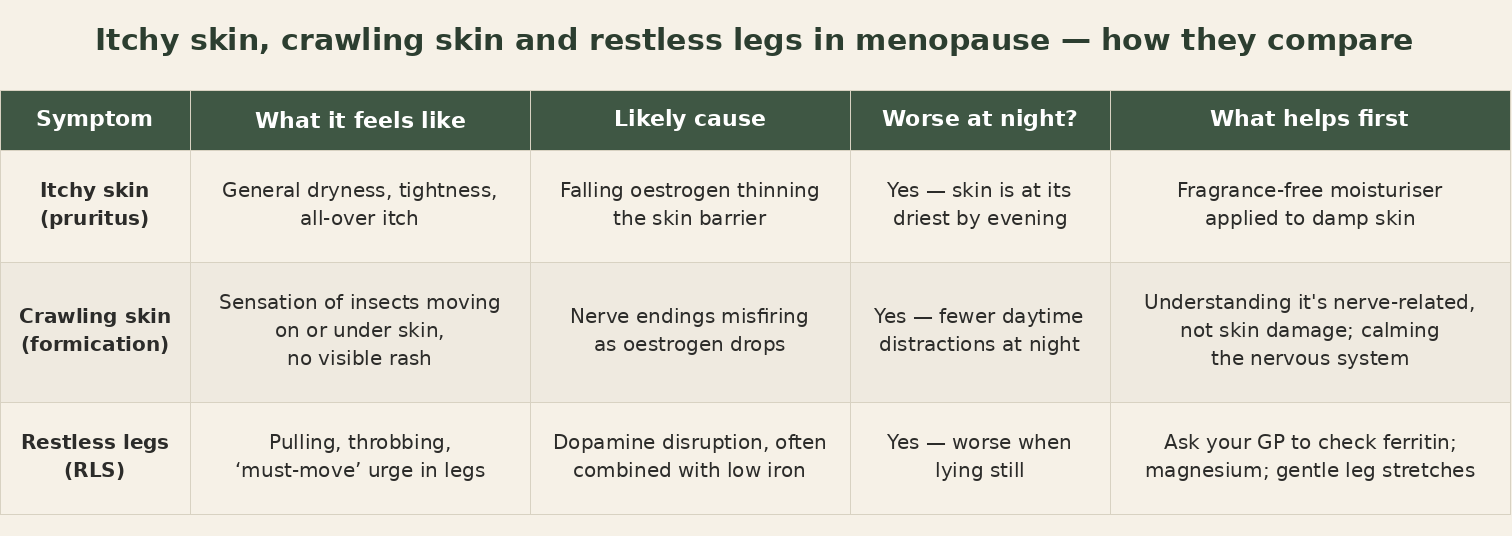
Itchy Skin, Formication and Restless Legs at a Glance
Three different sensations, three overlapping mechanisms, all pointing back to the same falling oestrogen. Here's how to tell them apart at a glance ↑
What Actually Helps Itchy Skin in Menopause
As a health coach working within the UKIHCA scope of practice, I can't diagnose skin conditions or prescribe treatments- but I can partner with you to implement lifestyle and nutritional strategies that support skin health from the inside out.
1. Hydration (Internal and External)
Internal hydration: Adequate water intake is foundational, but it's not the whole story. Your skin needs you to retain that water, which requires electrolyte balance and healthy fats.
Research shows that consuming foods rich in omega-3 fatty acids and maintaining adequate mineral intake (particularly sodium, potassium, and magnesium) supports cellular hydration.[20]
Practical approach:
Aim for 8-10 glasses of water daily, more if you're active or in heated/air-conditioned environments
Include mineral-rich foods (leafy greens, nuts, seeds, whole grains)
Don't be afraid of salt—adequate sodium helps you retain the water you're drinking
Include healthy fats at every meal (they support cell membrane health and moisture retention)
External hydration: Moisturising isn't optional anymore- it's essential for maintaining skin barrier function.
Studies show that regular application of emollients (moisturisers) significantly reduces itching and improves skin barrier function, particularly when applied to damp skin immediately after bathing.[21]
Practical approach:
Moisturise within 3 minutes of bathing whilst skin is still damp (this traps moisture)
Choose fragrance-free formulations with ceramides, hyaluronic acid, or glycerin (these ingredients rebuild and support the skin barrier)
Apply multiple times daily to very dry areas
Consider a thicker ointment (like petroleum jelly or an emollient-rich cream) at night for severely dry patches, especially on legs
Keep moisturiser by your bed for middle-of-the-night application if needed
2. Protein and Healthy Fats (Skin Barrier Support From Within)
Your skin barrier is made of proteins and lipids. When oestrogen declines, your body becomes less efficient at maintaining this structure. You need to provide the raw materials.
Protein: Essential for collagen synthesis and skin cell renewal. Aim for a palm-sized portion at every meal (25-35g). This isn't just about muscle- it's about maintaining the structural integrity of your skin.[22]
Healthy fats: Particularly omega-3 fatty acids (found in fatty fish, walnuts, flaxseeds) are incorporated into cell membranes throughout your body, including skin cells, where they help maintain barrier function and reduce inflammation.[23]
Research shows that omega-3 supplementation can improve skin hydration, reduce sensitivity and decrease inflammation.[24]
Practical approach:
Include fatty fish 2-3 times weekly (salmon, mackerel, sardines, herring)
If you don't eat fish, consider an algae-based omega-3 supplement (1-2g daily)
Cook with olive oil, include avocados, nuts, and seeds daily
Don't fear dietary fat - your skin needs it to rebuild its barrier
Additional skin-supporting nutrients:
Vitamin E (nuts, seeds, avocados, leafy greens): supports skin barrier function and reduces oxidative stress[25]
Vitamin C (citrus fruits, berries, bell peppers): essential for collagen synthesis[26]
Zinc (oysters, meat, pulses, nuts): supports wound healing and skin integrity[27]
Biotin and B vitamins (eggs, nuts, whole grains): support skin cell renewal[28]
3. Manage Environmental Triggers
Bath and shower practices:
Use lukewarm (not hot) water - hot water strips natural oils from skin
Limit bath/shower time to 10 minutes
Use gentle, fragrance-free cleansers (your skin barrier is compromised; harsh cleansers make it worse)
Pat dry rather than rubbing vigorously
Apply moisturiser immediately whilst skin is still slightly damp
Fabric choices:
Wear breathable, natural fabrics (cotton, bamboo, silk) next to skin
Avoid wool directly on skin if it triggers itching
Wash new clothes before wearing to remove chemical finishes
Use fragrance-free, gentle laundry detergents (fragrance is a common skin irritant)
Indoor environment:
Use a humidifier in winter when indoor heating dries the air (aim for 40-50% humidity)
Keep bedroom temperature cool (helps with night sweats and reduces nocturnal itching)
Avoid sitting directly next to heat sources
4. Nighttime-Specific Strategies
If nighttime itching is your primary issue:
Apply thick moisturiser to legs immediately before bed (this is non-negotiable if leg itching is waking you)
Keep legs cool -use lightweight bedding, point a fan towards the foot of the bed, consider loose cotton pyjama bottoms rather than going bare-legged
Consider an antihistamine 30-60 minutes before bed (speak with your pharmacist about appropriate options like cetirizine or loratadine)
Keep a cool, damp cloth by your bed -applying it to itchy areas can provide relief without damaging skin through scratching
Distraction techniques: when the urge to scratch is overwhelming, try applying firm pressure with your palm instead, or gently pinching the skin
5. Stress and the Nervous System Connection
Stress and itching have a bidirectional relationship: stress makes itching worse, and chronic itching increases stress.[29] During menopause, when your stress resilience is already under pressure, this cycle can become particularly vicious.
When your nervous system is in a heightened state, you become more sensitive to sensation generally - including itch. Two things tend to help most specifically here: regular relaxation practices (deep breathing, meditation, gentle yoga), which genuinely calm nerve sensitivity rather than just "feeling nice," and pausing before scratching - three slow breaths first, which interrupts the automatic stress-scratch response.
For the fuller picture on why your nervous system becomes more reactive in menopause and what helps calm it, why you feel overwhelmed in menopause covers that in depth.
6. Consider Medical Options
Whilst lifestyle strategies are powerful, some women benefit from additional support:
Topical treatments: Your GP or dermatologist may recommend specific barrier repair creams, topical steroids for short-term use during flare-ups, or antihistamine creams.
Menopause Hormone Therapy (MHT/HRT): For some women, restoring oestrogen levels addresses both the nerve misfiring causing formication and helps restore the skin barrier. This is worth an informed conversation with your doctor to understand whether it might be suitable for your individual circumstances.
Iron supplementation: If you're experiencing restless legs alongside itchy skin and your ferritin levels are below 75 µg/L, your doctor may recommend iron supplementation.[18]
Magnesium: Whilst out of my scope to recommend, some women explore magnesium supplementation (magnesium glycinate is often better tolerated). A relaxing magnesium-rich bath before bed is another option some find helpful for both skin and muscle relaxation.
FAQs
Is itchy skin a real symptom of menopause, or is it something else?
Yes - it's a recognised symptom linked to falling oestrogen's effect on skin hydration, collagen and nerve sensitivity, though it's still worth ruling out other causes if it's severe or persistent.
What does the "crawling" sensation in menopause actually feel like, and is it real?
It's called formication, and it's a genuine neurological response - nerve endings misfiring due to hormonal changes, not an actual skin problem or anything crawling on you.
Why is my itching so much worse at night specifically?
A combination of rising core temperature at bedtime, histamine naturally peaking overnight, and skin being at its most dehydrated by evening - all explained in more detail above.
Can restless legs and itchy skin be connected?
Yes, often - both are linked to falling oestrogen, and low iron (ferritin) is a common contributing factor worth asking your GP to check specifically.
Does formication mean something is wrong with my nerves? Not in the sense of nerve damage. It reflects a temporary change in how oestrogen-sensitive nerve endings in your skin are firing, not an underlying neurological condition. That said, if it's new, severe, or accompanied by other neurological symptoms, it's still worth a doctor’s check to rule out other causes.
How long does menopausal itchy skin usually last? There's no fixed timeline - for some women it eases once oestrogen stabilises post-menopause, for others it persists longer and responds better to ongoing skin barrier support. Consistency with hydration and moisturising tends to matter more than time alone.
Will HRT stop the itching and restless legs? For some women, yes - restoring oestrogen can ease both the nerve misfiring behind formication and the dopamine disruption behind restless legs. It isn't guaranteed or suitable for everyone, so it's worth discussing directly with your doctor.
What's the difference between menopausal itching and an allergic reaction? Menopausal itching tends to be diffuse, without a rash, and often worse at night regardless of what you've touched or eaten. An allergic reaction usually has a clearer trigger, can come with visible hives, swelling or redness, and doesn't follow the same evening pattern. If you're unsure, or the itching is sudden and severe, get it checked rather than assuming it's hormonal.
Should I take magnesium or iron without a GP/doctor’s check first? Iron shouldn't be taken as a blanket supplement without a blood test - too much iron can be harmful, and the useful number here is ferritin, not just haemoglobin. Magnesium is generally lower-risk for most women, but it's still worth mentioning to your GP or pharmacist, particularly if you're on other medications.
When to Seek Medical Assessment
Whilst many cases of menopausal itching respond to the strategies above, certain symptoms warrant professional evaluation:
Intense itching with visible rash, blistering, or skin changes (could indicate dermatitis, eczema, or other skin conditions)
Itching that interferes significantly with sleep or daily functioning
No improvement after 4-6 weeks of consistent skin barrier support
Itching accompanied by jaundice (yellowing of skin/eyes) (could indicate liver issues)
Severe, sudden onset itching (could indicate allergic reaction or other medical condition)
A doctor/GP or dermatologist can rule out other causes (thyroid disorders, liver disease, kidney disease, medication reactions, skin conditions) and provide targeted treatment if needed.changes.
What Helps From Here
Itchy skin, restless legs and broken sleep tend to arrive as a pattern, not three isolated problems - which means the fix usually isn't three separate fixes either.
That's often the point where knowing more about why it's happening matters less than knowing what to actually do about it - which is where a bit of personalised support can make things click faster than reading alone.
If you want a clearer sense of what's going on and where to start, the Perimenopause Blueprint is a free guide built for exactly this.
→ Start with your personalised perimenopause blueprint
Or if it's easier to talk it through, a Menopause Clarity Call is a free, no-pressure conversation.
Book a free Menopause Clarity Call →
References
Thornton MJ. Estrogens and aging skin. Dermatoendocrinol. 2013;5(2):264-270. PMID: 24194966
Brincat M, et al. Skin collagen changes in postmenopausal women receiving different regimens of estrogen therapy. Obstet Gynecol. 1987;70(1):123-127. PMID: 3601260
Pierard-Franchimont C, et al. A quantitative biometrological assessment of acne and hormonal evaluation in young women using a triphasic low-dose oral contraceptive containing norgestimate. Eur J Contracept Reprod Health Care. 2000;5(4):275-286. PMID: 11245555
Pochi PE, et al. Age-related changes in sebaceous gland activity. J Invest Dermatol. 1979;73(1):108-111. PMID: 448169
Verdier-Sévrain S. Effect of estrogens on skin aging and the potential role of selective estrogen receptor modulators. Climacteric. 2007;10(4):289-297. PMID: 17653955
Elias PM. Skin barrier function. Curr Allergy Asthma Rep. 2008;8(4):299-305. PMID: 18606081
Brincat M, et al. A study of the decrease of skin collagen content, skin thickness, and bone mass in the postmenopausal woman. Obstet Gynecol. 1987;70(6):840-845. PMID: 3120067
Ständer S, Steinhoff M. Pathophysiology of pruritus in atopic dermatitis: an overview. Exp Dermatol. 2002;11(1):12-24. PMID: 11952824
Rimoin LP, et al. Female-specific pruritus from childhood to postmenopause: clinical features, hormonal factors, and treatment considerations. PMID: 23551372
Sohrabji F, et al. The effect of estrogen on cutaneous nerve growth factor. PMID: 8301349
Pfeilschifter J, et al. Changes in proinflammatory cytokine activity after menopause. Endocr Rev. 2002;23(1):90-119. PMID: 11844745
Kanda N, Watanabe S. Regulatory roles of sex hormones in cutaneous biology and immunology. J Dermatol Sci. 2005;38(1):1-7. PMID: 15795118
Jensen F, et al. Estradiol and progesterone regulate the migration of mast cells from the periphery to the uterus and induce their maturation and degranulation. PLoS One. 2010;5(12):e14409. PMID: 21203555
Okamoto-Mizuno K, Mizuno K. Effects of thermal environment on sleep and circadian rhythm. J Physiol Anthropol. 2012;31(1):14. PMID: 22738673
Smolensky MH, et al. Circadian mechanisms of 24-hour blood pressure regulation and patterning. Sleep Med Rev. 2017;33:4-16. PMID: 27076261
Yosipovitch G, et al. Time-dependent variations of the skin barrier function in humans: transepidermal water loss, stratum corneum hydration, skin surface pH, and skin temperature. J Invest Dermatol. 1998;110(1):20-23. PMID: 9424081
Barth C, et al. (2015). Estradiol and the reward system in humans. Frontiers in Human Neuroscience.
Allen RP, et al. Evidence-based and consensus-based recommendations for the iron treatment of restless legs syndrome. Sleep Med. 2018;22:S105-S113. PMID: 29425576
Abbasi B, et al. The effect of magnesium supplementation on primary insomnia in elderly: A double-blind placebo-controlled clinical trial. J Res Med Sci. 2012;17(12):1161-1169. PMID: 23853635
Cao C, et al. Diet and skin aging—From the perspective of food nutrition. Nutrients. 2020;12(3):870. PMID: 32213934
Lodén M. Role of topical emollients and moisturizers in the treatment of dry skin barrier disorders. Am J Clin Dermatol. 2003;4(11):771-788. PMID: 14572299
Leidy HJ, et al. The role of protein in weight loss and maintenance. Am J Clin Nutr. 2015;101(6):1320S-1329S. PMID: 25926512
McCusker MM, Grant-Kels JM. Healing fats of the skin: the structural and immunologic roles of the omega-6 and omega-3 fatty acids. Clin Dermatol. 2010;28(4):440-451. PMID: 20620762
Kawamura A, et al. Dietary supplementation of gamma-linolenic acid improves skin parameters in subjects with dry skin and mild atopic dermatitis. J Oleo Sci. 2011;60(12):597-607. PMID: 22123240
Thiele JJ, Ekanayake-Mudiyanselage S. Vitamin E in human skin: organ-specific physiology and considerations for its use in dermatology. Mol Aspects Med. 2007;28(5-6):646-667. PMID: 17719081
Pullar JM, et al. The roles of vitamin C in skin health. Nutrients. 2017;9(8):866. PMID: 28805671
Gupta M, et al. Zinc therapy in dermatology: a review. Dermatol Res Pract. 2014;2014:709152. PMID: 25120566
Zempleni J, et al. Biotin. Biofactors. 2009;35(1):36-46. PMID: 19319844
Schut C, et al. Psychophysiology of itch. Exp Dermatol. 2015;24(9):652-656. PMID: 41636342
