
Perimenopause, Solo Parenting and the Invisible Load: Key Themes from My Session with Single Mothers by Choice
There is a particular kind of exhaustion that doesn't show up on a blood test.
It's the 3am wake-up where you can't get back to sleep - and you're not sure if that's the perimenopause, the fact that you're doing all of this alone, or both. It's the brain fog that makes you question yourself at work. The irritability that leaves you feeling unlike yourself. The creeping sense that your body is changing in ways nobody warned you about, at exactly the point in life when you have least bandwidth to deal with it.
I was recently invited to speak with the Single Mothers by Choice (SMC) community from the USA and it turned out to be one of the most resonant conversations I've had in my work as a menopause health coach. The questions submitted ahead of the session - and the honesty in the room on the day - confirmed something I see constantly in my coaching work: these women are not lacking information or effort. They are lacking a framework that actually fits their lives.
This is my attempt to capture the key themes we explored and to answer some of the questions the community brought.
Why This Conversation Needed to Happen
Most menopause education is built around a fairly narrow picture: a woman in a long-term relationship, perhaps with grown or nearly-grown children, moving through midlife with at least some shared domestic load.
That picture doesn't fit a significant and growing group of women.
Single mothers by choice - whether through donor conception, solo adoption or other routes - are often parenting young children through perimenopause. Some are still navigating fertility decisions while experiencing early hormonal shifts. Many are carrying an unshared mental, emotional and physical load at the exact moment their bodies are asking for more recovery, more support and more attention. Solo parenting often means sustained hypervigilance, fragmented recovery time and chronic cognitive load - all of which interact directly with hormonal change.
This isn't a niche concern. It's just a conversation that hasn't been had loudly enough yet.
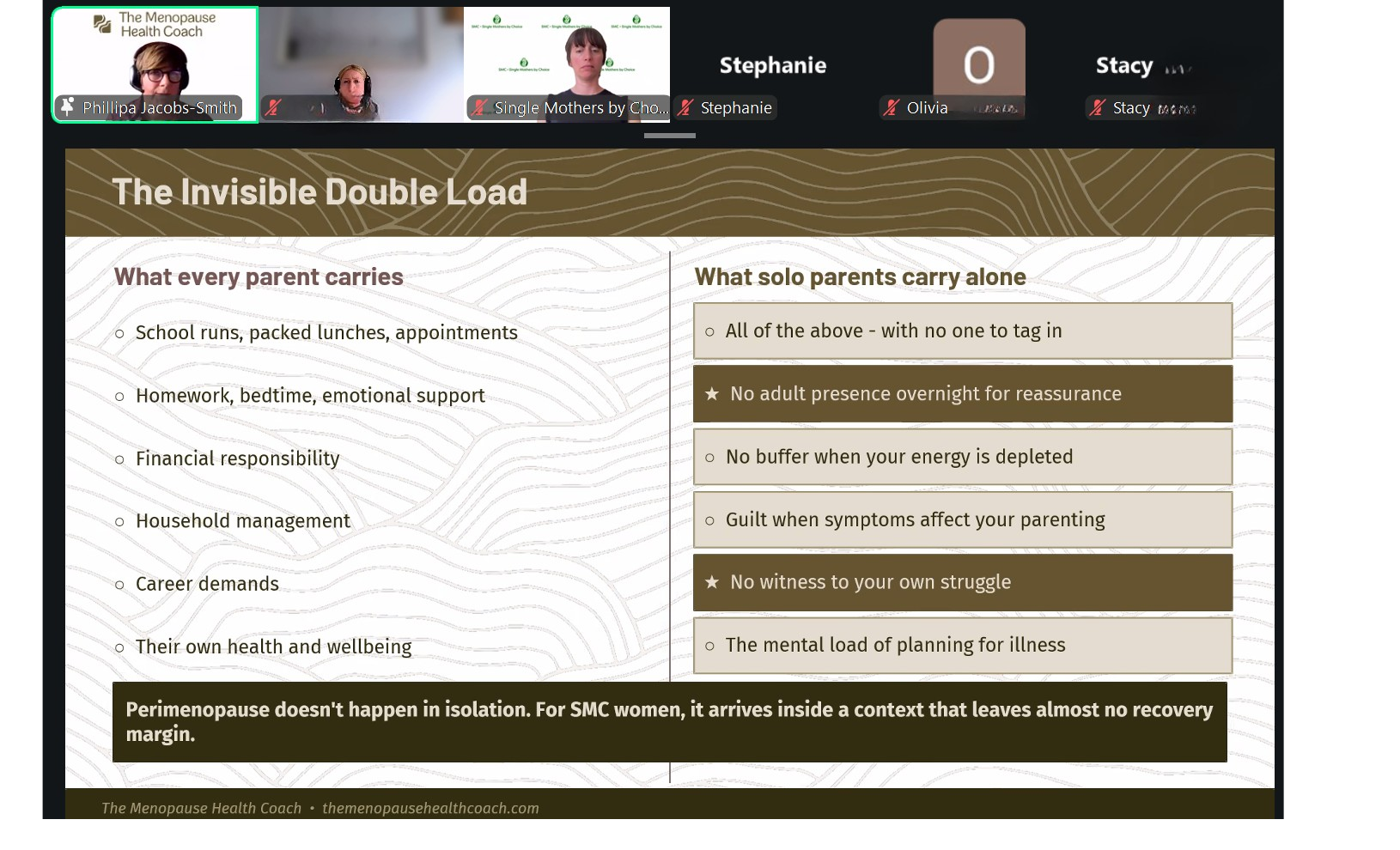
Phillipa Jacobs-Smith speaking to the Single Mothers by Choice community about perimenopause, solo parenting and the invisible double load.
The Hormone Picture Nobody Tells You About
Perimenopause doesn't begin at 50. For many women, hormonal shifts start in the late 30s or early 40s - sometimes earlier. Oestrogen, progesterone and testosterone don't decline in a straight line; they fluctuate, often dramatically, before they settle into a lower range.
What this produces is a symptom picture that is often misunderstood, misattributed, or missed entirely: anxiety that appears from nowhere, sleep that becomes unpredictable, cycles that change, moods that feel disconnected from circumstances, energy that crashes in ways that willpower can't fix.
One of the questions submitted ahead of the session captures the complexity of this perfectly: "If I'm in perimenopause, can I still conceive?" It's a question that could only come from a room like this one. And it speaks to how much overlap there is between the hormonal shifts of perimenopause and the fertility journey many SMC women are still on - or have recently completed. The honest answer is that perimenopause and fertility exist on a continuum, not in separate boxes, and that anyone navigating this intersection deserves specialist medical advice alongside whatever else they're doing. What I can say is that understanding your hormonal picture - really understanding it, not just waiting for a diagnosis - is the essential starting point.
Another question that came in asked at what age women should consult the medical community about HRT/MHT. There is no single right answer, but my view is: earlier than most women think. If you are experiencing symptoms that are affecting your quality of life -sleep, mood, energy, cycle changes, cognitive function - those symptoms are worth investigating regardless of your age. You do not need to be in your 50s, and you do not need to wait until things become unbearable. A menopause-informed GP or specialist is the right first port of call for any conversation about HRT.
Sleep, Weight and the Questions Everyone Has But Doesn't Always Ask
Sleep disruption and weight gain came up repeatedly - including as a direct pre-submitted question. These two things are deeply connected during perimenopause, and not always in the way people expect.
Fluctuating oestrogen disrupts the sleep architecture that allows you to reach and sustain deep, restorative sleep. At the same time, the cortisol that rises when you are chronically under-slept drives fat storage - particularly around the abdomen - and increases cravings for fast-release carbohydrates. So the weight gain that many perimenopausal women experience isn't simply a calorie problem. It's a hormonal and metabolic problem and it responds best to hormonal and metabolic solutions.
Blood sugar regulation matters enormously here. Fluctuating oestrogen affects insulin sensitivity. When blood sugar is unstable - spiking and crashing through the day - it compounds fatigue, worsens mood, disrupts sleep further and increases cortisol. For a solo mother running on limited sleep and high demand, this cycle can feel impossible to break.
Small, consistent changes to how and when you eat can make a meaningful difference: prioritising protein at breakfast, avoiding long gaps without food, reducing the ultra-processed foods that drive rapid blood sugar spikes. None of this requires perfection. But it does require understanding why it matters - which most women are never told.
"I'm Doing Everything Right and Still Suffering- Am I Missing Something?"
This question was submitted ahead of the session and I want to answer it properly, because it represents something I hear from women regularly - and because it matters.
The woman who asked it is 52, on HRT for over a year, has a young child via IVF, has steadily increased her dose, eats well, exercises, takes supplements, maintains her social connections - and is still experiencing weight gain, sleep disruption and significant irritability. She asked, with obvious frustration: "Am I missing something?"
Yes. But it is not something she has failed to do. It is something she has not been told.
HRT Helps - But It Is Not the Whole Picture
HRT/MHT is profoundly important for many women, and I am not qualified to advise on it - that is your doctor's domain. What I can speak to is what HRT/MHT does and does not do. HRT/MHT addresses hormone deficiency. It replaces what is declining. That is genuinely valuable, and for many women it is life-changing.
But perimenopause does not only deplete hormones. It also disrupts the foundations that support hormonal function: sleep quality, blood sugar regulation, cortisol patterns, gut health, nutrient status and the capacity of the nervous system to recover. These foundations are not restored by HRT/MHT. They require their own attention - and in the context of solo parenting a young child, they are under sustained, significant pressure.
So if you are on HRT/MHT and still not feeling well - if you are doing all the things and still suffering - it is worth asking: what is the load my body is actually carrying? Not just hormonally, but physiologically. And what would it look like to address that systematically, rather than simply increasing the dose?
This is precisely the work I do with my clients. Not instead of medical care, but alongside it.
On Medications and the Long-Term Question
The community also asked about staying on HRT/MHT and related medications long-term - whether it is safe to remain on oestrogen, progesterone, testosterone and other treatments over time.
This is an important and completely valid question, and one your prescribing doctor or menopause specialist is best placed to answer in the context of your individual health history. What I would say is that the evidence base around HRT/MHT - particularly body-identical hormones - has shifted significantly in recent years, and many women are now appropriately supported on long-term HRT/MHT where that is clinically suitable. The key is regular review with a medical professional who is genuinely up to date on menopause medicine, not working from outdated risk assumptions.
If you do not feel you are getting that quality of review from your current GP, seeking a menopause specialist - through the British Menopause Society's directory, for example - is a reasonable and worthwhile step.
What I Want You to Take Away
If you are a single mother by choice and you are experiencing symptoms you cannot quite explain - fatigue that rest doesn't fix, sleep changes, mood shifts, brain fog, cycle changes, anxiety, loss of motivation - please do not assume it is just the parenting.
It might also be perimenopause. And perimenopause is something you can work with.
You do not need to white-knuckle your way through this decade. You do not need to accept exhaustion as the price of the choice you made. And if you are already on HRT/MHT and still not feeling well, that is not a dead end - it is a signal that there is more to address and support available to help you address it. There is support for perimenopause symptoms and coaching is very much a part of that.
I’m grateful to the Single Mothers by Choice community for creating space for this conversation so openly and honestly
A Note on Scope
As a certified Nutrition and Health Coach (trained through IINH and accredited by UKIHCA), I work within a defined scope of practice - nutrition, lifestyle and health coaching, not medical diagnosis or treatment. Everything in this article relating to HRT/MHT and medication is for informational context only. Please work with your GP or a menopause-specialist doctor for all medical decisions. Coaching and medical care are not in competition - they work best together.
Want to Talk?
If any of this resonated - whether you are an SMC member, a solo parent, or simply a woman who feels like something is shifting and you are not sure what to do about it - I offer a free 30-minute Menopause Clarity Call.
Even if we decide coaching isn't right for you, you'll leave with clarity.
Book your free Menopause Clarity Call →
and you can explore more about nutrition and lifestyle support for perimenopause
